


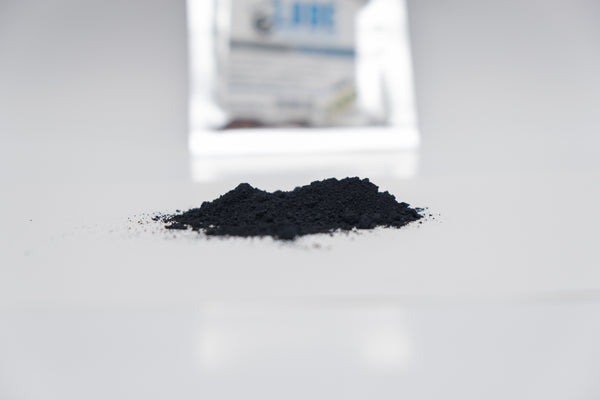


Flake graphite MG3096
Bulk packaging 20kg
Graphite powder, 96% carbon content, grain size up to 5μm
Pure, highly selected crystalline graphite for industrial purposes, miscible with many chemicals, including lubricants (e.g. graphite grease)
Polish Product Evil Lubricants
Flake graphite is a variety of natural graphite with a highly ordered structure.
Crystalline. It results from the metamorphism of carbon-rich organic substances, similar to hard coal. Flake graphite has a characteristic metallic luster, which is why it is also called silver or crystalline graphite.
Features and Advantages
- good thermal and electrical conductivity,
- low coefficient of thermal expansion,
- high chemical and thermal resistance,
- excellent lubricating properties.
- high anisotropy
Applications Applications
- for the production of lubricants,
- for anti-corrosion and reflective paints and coatings,
- for and impregnation of sealing and insulating materials,
- for forging coatings and separators,
- for battery cores, electrodes and electrotechnical accessories,
- for composites and plastics, cemented carbides, cermets, explosives, in laboratory technology.
- in metal casting,
- for fireproof materials,
- for antistatic coatings,
- for friction and brake linings
- for anti-inflammatory protectors,
- for polymer materials, elastomers, foams, polystyrene (ground graphite EG 096 with powder consistency)
Metal foundry (Flag graphite FG 192, MG 192 and in the form of dispersion MG-4 is used to create coatings as a separator of foundry patterns and molding sands, where it also acts as a refractory coating protecting castings against external defects such as burns, penetrations and scabs)
Production of black refractory materials, crucibles, retorts, furnace lining elements FG 192, FG 395 (The addition of graphite plasticizes the mass and facilitates forming, furthermore improves the quality of finished products, increases their fire resistance, chemical resistance, significantly reduces friction and the coefficient of thermal expansion)
Special greases (fine flake graphite MG 394 and micropowders MG 1596 and 3096 are used to produce greases in the form of pastes. Graphite powders can be an additive to lithium, calcium greases or bentonite masses, increasing their durability at high temperatures)
Antistatic coatings (graphite is used as a charge passivator in antistatic coatings. It is a proven component in the production of explosion-proof curtains, mining linings and foils, and is an additive to flooring, conductive and antistatic coatings. MG 394 type graphite is most often used to produce these materials)
Friction and brake linings (graphite types used: MG 192 and MG 394. The addition of graphite to the friction material increases its thermal conductivity, resistance to abrasion and rapid temperature changes)
Flame-retardant protectors. EG modified graphite is added to various types of insulation, materials, and coatings to increase fire resistance (as a flame retardant or flame retardant). EG 290 graphite is intended as an additive to bituminous coatings, fire barrier seals, and fire-resistant coatings.
Properties of Flake Graphite MG3096
| Carbon content min. | Grain size | % faction / expansion | Maximum humidity | Bulk density |
| 96% | <5 μm | 50% | 2% | ~0.13-023 g/cm³ |
Graphite Production
Graphite is a variety of carbon with a black-gray color and a metallic sheen. It is very soft (graphite hardness is 1 on the Mohs scale), susceptible to abrasion, and cleavage. It has excellent lubricating properties, is greasy to the touch, and is resistant to high temperatures. It exhibits high mechanical resistance to compression and low tensile strength. Furthermore, graphite and graphite products are insoluble in water, characterized by low chemical reactivity, ease of storage and disposal, and no negative impact on the environment. These characteristics have earned it the reputation as a modern and simultaneously ecological material.
Flake graphite is obtained from ores with a carbon content of up to 10%. After appropriate purification through flotation, the graphite content reaches 85%. Chemical refining then increases the content to 96%, and after thermal refining, even to 99.99%.
Types of Flake Graphite
| Type | Carbon content min. | Grain size | % faction / expansion | Maximum humidity | Bulk density |
| FG 395 | 95% | >500 μm | 80% | 2% | ~0.6 g/cm³ |
| FG 192 | 92% | >500 μm | 80% | 3% | ~0.5 g/cm³ |
| MG 192 | 92% | >500 μm | 90% | 3% | ~0.5 g/cm³ |
| MG 394 | 94% | >45 μm | 90% | 2% | ~0.4 g/cm³ |
| MG 1596 | 96% | <10 μm | 50% | 2% | ~0.2-0.3 g/cm³ |
| MG 3096 | 96% | <5 μm | 50% | 2% | ~0.13-0.23 g/cm³ |
| EG 096 | 96% | 0 – 0.15 mm | 50-90 ml/g | 2% | ~0.6 g/cm³ |
| EG 290 | 90% | 0.2 – 0.6 mm | 200-300 ml/g | 2% | ~0.65 g/cm³ |
| EG 394 | 94% | 0.4 – 0.9 mm | 300-400 ml/g | 2% | ~0.6 g/cm³ |
| MG-4 | 94% | <8 μm | 0.5 | water 70% | Dispersion |
Product title
Vendor
€19,99 EUR | €24,99 EUR
Product title
Vendor
€19,99 EUR | €24,99 EUR
Product title
Vendor
€19,99 EUR | €24,99 EUR
Product title
Vendor
€19,99 EUR | €24,99 EUR
Let customers speak for us
Szybko , profesjonalne produkty , polecam

Wszystko super
wszystko ok

szybka dostawa-produkt dobry.
szybka i sprawna dostawa

Super zakup

Spełnia oczekiwania

Szybko, sprawnie Ok

100% polecam idealnie współpracuje wedle wytycznych z innym produktem.

Obsługa klienta bez zarzutu. Super.

Bardzo dobry produkt. Już 3 tygodnie minęły od smarowania zawiasów piekarnika i jest bardzo dobrze. Polecam

Zeer blij met dit produkt vanwege de extreme fijnheid (0,85 micron) van het produkt.

Produkt zgodny z opisem śmiało polecam
Szybka realizacja zamówienia

Doet wat het moet doen.
super sklep błyskawiczna wysyłka polecam