
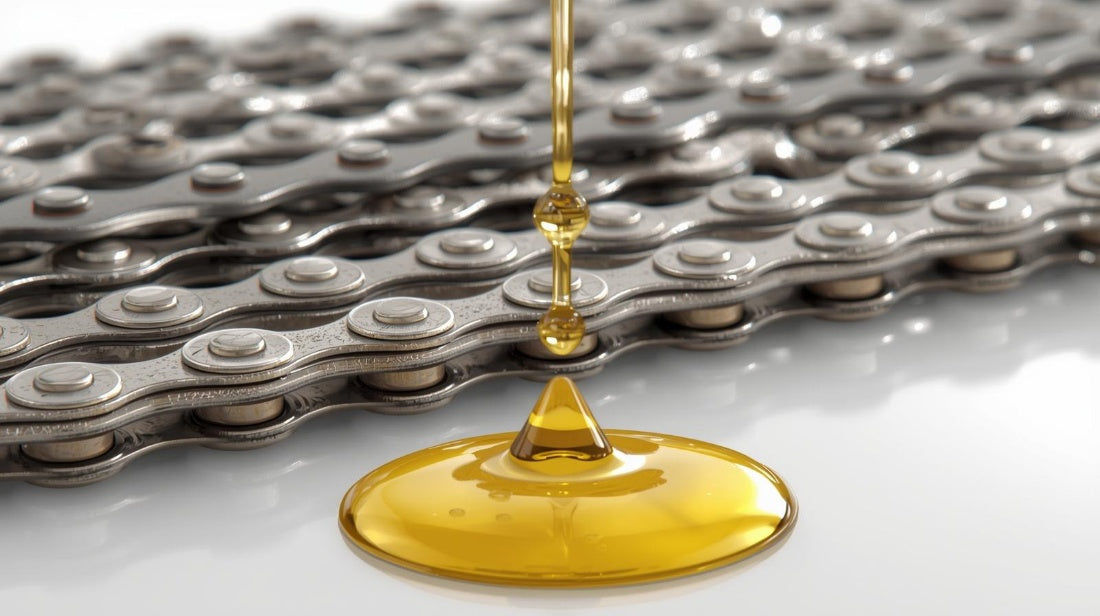
What chain lubricant

The question "what chain lubricant?" is only seemingly simple, as there's no single answer. A chainsaw chain lives in sawdust and resin, a butcher shop chain is showered with detergents, and a bicycle chain struggles with rain, dust, and the owner's ambitions. The mechanism is the same (pins, bushings, rollers)—but the operating conditions and purpose are completely different.
1) What does chain lubricant do – 60 seconds of tribology
The pin-bushing assembly operates primarily in a boundary and mixed regime : the lubricant film can be very thin, and the movement involves both rolling and sliding. The lubricant has:
- to go inside (penetrate), not just shine on the outside,
- leave a film that will not disappear after the first rain,
- protect against corrosion and wear,
- do not make abrasive paste with dust.
It's simple, but in practice it leads to different recipes: from heavy oils with adhesive additives, through synthetic esters with low coking, to waxes and dry PTFE/h-BN films.
2) Three worlds of the chain: chainsaw, butcher shop, bicycle
A. Chainsaw – Bar & Chain Lubrication
The role of the chain : it cuts, dissipates heat from the guide bar, does not fall or "float".
Conditions : very high speeds, chips, resin, dust, often frost or heat.
What grease?
There's no philosophy here – it's bar and chain oil . This isn't an "inside the links" lubricant like in a drivetrain; it's a viscous oil with a tackifier (adhesive additive) that:
- holds the chain at high speeds,
- cools and lubricates the guide, roller and links from the outside,
- It is not thrown out in a second by centrifugal force.
Seasonal viscosity : roughly ISO VG 100–150 for cold weather and VG 150–220 for summer. In winter, we choose "winter" versions (pumpability!), in the forest often biodegradable (vegetable/synthetic esters).
Mistakes : pouring engine oil "because I have it at hand" - it splashes, makes it dirty and does not protect the guide bar; too thick oil in winter - it does not flow, the guide bar runs dry.
A pro tip , or short, practical advice from an expert : adjust the oil dispenser and clean the guide bar channels. If the guide bar is dry, no brand of chain will last.
B. Butcher's shop (food industry) – conveyor chains and hooks
The role of the chain : transport and lifting – it must run evenly, quietly and without interruptions.
Conditions : CIP cleaning , water, steam, aggressive detergents, low/variable temperature, audit requirements.
What grease?
This is the world of H1-registered lubricants (accidental contact with food permitted). Most commonly:
- PAO/H1 ester oils with high washout resistance and anti-corrosion protection,
- in washers and steam zones – detergent-resistant recipes,
- at high temperature (baking, heat tunnel) – high-temperature H1 esters with low coking ; extreme: PFPE H1 (expensive, but clean and stable).
Application : Central lubrication is best, using a thin stream – continuous, small doses. Applying grease "once a week from a gun" results in friction fluctuations, noise, and uneven operation.
Documentation : in the food industry, the H1 card , resistance to cleaning agents and the lubrication protocol (HACCP) are important .
Lubrication errors : use of "universal" industrial oil (no H1), coking oil in tunnels (lacquer and seizing of links), lack of resistance to detergents - the grease disappears after one wash.
Pro tip : if the chain is in the direct splash zone of water and detergent, consider a semi-dry film or a formula with adhesive additives, and shorten the interval – better more often, but with a thinner dose.
C. Bike - Lubrication in "Clean Drive Means Happy Drive" Mode
The role of the chain : transferring power quietly and efficiently.
Conditions : dust, rain, salt, different riding styles (road, gravel, MTB), expectation "it has to be quiet and clean".
What grease?
Not a "grease" in the sense of a solid lubricant, but a chain lubricant . We have three families:
1. Wet – oil with additives (sometimes PTFE, boron nitride, molybdenum disulfide):
- Advantages : good penetration, better rain resistance, quiet operation.
- Cons : Collects dust; requires careful wiping off of excess.
- For whom : commuting, autumn-winter, marathons in the mud.
2. Dry / wax (dry, wax) – wax emulsion; after evaporation, a dry film remains :
- Advantages : clean, little black paste, low resistance in dry conditions.
- Cons : worse in heavy rain, requires perfectly degreased chain and more frequent reapplication.
- For whom : summer, dusty road/gravel, cleanliness maniacs.
3. Semi-dry (hybrids) – light carrier, after a while semi-dry film:
- Pros : cleanliness/resistance trade-off; less cleanup than after a wet wipe.
- Cons : still needs to be applied properly and the excess wiped off.
- For whom : all-round, variable conditions without extremes.
"Ceramic" in the name? Treat it as a marketing tip , not dogma. What matters is the carrier and the procedure : degreasing, application on the inside of the cells, time for penetration , wiping off excess, and the appropriate interval .
Errors : universal sprayer "because it's faster", lack of cleaning before changing the type of lubricant (the wax will not stick to the oil film), lubrication "just before going out" - the carrier will not have time to evaporate.
Pro tip : in MTB/dust conditions, consider wax/ceramic dry , but in rain, go back to wet . When changing technology, consider full degreasing (jar + degreaser + drying).
3) Other common scenarios because the chain has a million uses
- Conveyors in paint shops/dryers : high temperature → low-coking esters , with extreme PFPE . Lubricate frequently, sparingly, while warm (but not "red hot").
- Forklifts (leaf chain, mast) : high pressures, small movements, dust → sticky adhesive oil ; when dust is extreme, consider semi-dry/dry film (but monitor wear).
- Chains in car washes/treatment plants : water + chemicals → oils with high resistance to washing out and corrosion inhibitors .
4) How to choose in 5 steps
- Role of the chain : cutting (chainsaw), driving/sliding (conveyor), "sports" (bicycle).
- Operating conditions : temperature, water/detergents, dust/sand, food contact (H1?), speed.
- Film type : sticky adhesive (chainsaw), wash-resistant/H1 (butcher shop), wet/dry/semi-dry (bicycle).
- Application : central lubrication vs manual; seasonal viscosity (chainsaws), interval (bike/UR).
- Service and cleanliness : cleaning, degreasing when changing technology, documentation (HACCP in food).
5) Composition – what to ask the supplier
- Base : mineral/PAO/ester/PFPE? (Coking, chemical resistance, price).
- Additives : EP/anti-corrosion; on a bike – is it wax/oil? Are there any solid particles (PTFE, molybdenum)?
- Viscosity (40 °C) : adapted to temperatures and method of administration.
- Resistance to washing out : key in butcher shops and washers.
- Registrations : H1 in food, biodegradable in the forest.
- Working temperature : paint shops/dryers do not forgive an inappropriate base.
6) Application
- First clean: remove varnish, mud, old film.
- Dosage should be modest but frequent (better a little-often than a lot-infrequently).
- Where the node works: inside the gear (bicycle), in the guide (saw), on the pins-rollers (conveyor).
- Time for media penetration/evaporation.
- Wiping off excess – dirt sticks to the “shiny” outside.
- Control: operating temperature, noise, current consumption (in conveyors), tension and elongation.
7) Mistakes That Cost You (And How to Avoid Them)
- “One grease fits all” – leads to coke in the furnace, corrosion after washing, and muddy paste on the bike.
- Changing technology without cleaning – wax does not adhere to oil, PFPE and mineral oil may be incompatible.
- Wrong viscosity vs season (chainsaw) – pump does not feed, guide bar dry.
- Lack of H1 in food – a problem during the audit and a risk for the brand.
- Just a "spray from the outside" – it looks nice, but the inside of the cells is hungry.
8) Quick summary
- Chainsaw (cutting) : bar & chain with tackifier; VG 100–220; winter/summer; often bio .
- Butcher shop (H1, washing) : PAO/ester H1 , resistance to detergents and washing; at temperature – esters HT/PFPE H1 .
- Bike (drive) : wet for rain, dry/wax for dust, semi-dry for everyday use; procedure > marketing.
Summary of what chain lubricant to choose
"Which chain lubricant?" – such as the conditions and role of the chain . In a chainsaw, grip and guide bar cooling are key; in a butcher shop, H1 and washability are key; in a bicycle, cleanliness vs. rain resistance and proper procedure are key. If you stick to the rule: terrain first, then chemicals, and finally application technique , the chain will reward you with quiet, long-lasting operation. And we, traditionalists, like things that "just work" – without fuss and surprises.
Regardless of what chain you want to lubricate, remember, if you don't find the right lubricant yourself, call 601 444 162.